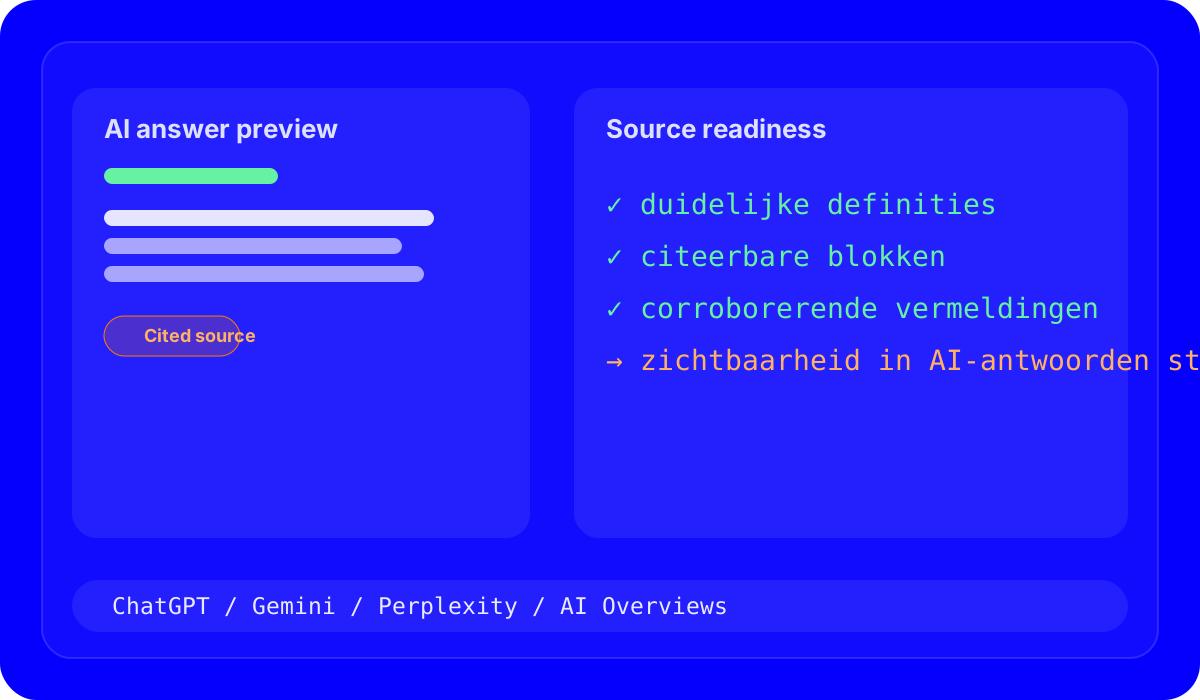
What GEO services actually do
Where classic SEO mainly focuses on rankings in search results, GEO focuses on visibility inside generated answers. That means your content must not only be discoverable, but also citable, understandable and consistent with other trustworthy sources. Companies searching for GEO services or ChatGPT optimization usually are not looking for a trick. They want to understand how their brand appears when prospects ask questions in AI systems.
GEO is not a replacement for SEO either. The two disciplines overlap heavily. Strong classic SEO often improves the foundation for GEO, but AI systems place different demands on clarity, entities, source quality and external corroboration. That is why GEO usually requires an additional strategic layer on top of your existing content work.
Which platforms matter most today
- ChatGPT: often the starting point for research, summarization and vendor discovery.
- Google AI Overviews: blends classic search results with summarized answers and source references.
- Gemini and Perplexity: especially strong for comparison, synthesis and questions that require multiple sources.
Which signals help AI systems
AI systems need clear, structured content that genuinely defines and frames a topic. Strong GEO content names concepts explicitly, uses consistent terminology, gives direct answers, cites where relevant and avoids vague marketing language. External signals matter too: brand mentions, quotes, sources that confirm your expertise and a clear relationship between author, brand and topic.
This is also why generic marketing copy performs poorly in AI contexts. It says too little that is concrete enough to be useful in an answer. Models often look for text fragments that are compact, informative and easy to reuse.
AI systems work better with pages that define terms sharply than with vague marketing copy.
Your website and external mentions should reinforce each other rather than contradict each other.
Answer blocks, FAQs and comparison content increase the chance that a model will use your material.
When GEO becomes commercially relevant
If prospects already explore your category through ChatGPT or AI Overviews, visibility in generated answers becomes a discovery and credibility layer on top of SEO. At that point, classic rankings alone are no longer enough.
View GEO servicesWhich content formats work best for GEO
For many companies, service pages, definitions, FAQs, how-to guides and comparison content form the strongest base. Not because every article will rank, but because those formats work well as source material. Pages that answer one question clearly or unpack one topic in a structured way are more likely to be picked up.
Why source authority is crucial
An AI model rarely wants to trust a single source. That is why your own site and your external signals need to reinforce each other. GEO is also about earned media, co-citations, mentions on relevant sites and a clearly legible brand profile. If your site claims something that is not confirmed anywhere else, models are less likely to treat it as a strong source.
| Weaker GEO signal | Stronger GEO signal |
|---|---|
| Generic marketing language | Clear definitions and answer blocks |
| No external confirmation | Brand mentions and corroborating sources |
| Many disconnected articles without structure | A clear layer of service pages, guides and FAQ content |
How to measure GEO realistically
There is not yet one perfect standard tool for GEO measurement. So it is better to combine several observations: does your brand appear in AI answers, are your pages cited, which question types trigger your content, and how does branded or assisted demand shift afterward? The mistake is to reduce GEO to a single ranking-like metric. It behaves more like a visibility system on top of SEO.